
Kilojoules vs Calories: What’s the Difference & How to Convert Them
If you have ever downloaded a new fitness app, bought an imported snack, or traveled abroad, you have probably experienced a moment of sheer nutritional panic. You look at the back of a simple granola bar and see a massive number like “800.” Before you assume that tiny snack will ruin your health goals for the entire week, take a breath. You are likely looking at kilojoules, not calories.
The global debate of calories vs kilojoules confuses millions of people every year. Some countries swear by one, while other nations firmly rely on the other. But what do these numbers actually mean for your diet, your health, and your waistline?
In this comprehensive guide, we will break down exactly what these terms mean, explore the difference between calories and kilojoules, and show you exactly how to convert kilojoules to calories quickly and accurately.
What is a kJ? The Science of Energy
To understand the metrics on your food label, we first need to define our terms. So, what is a kJ exactly?
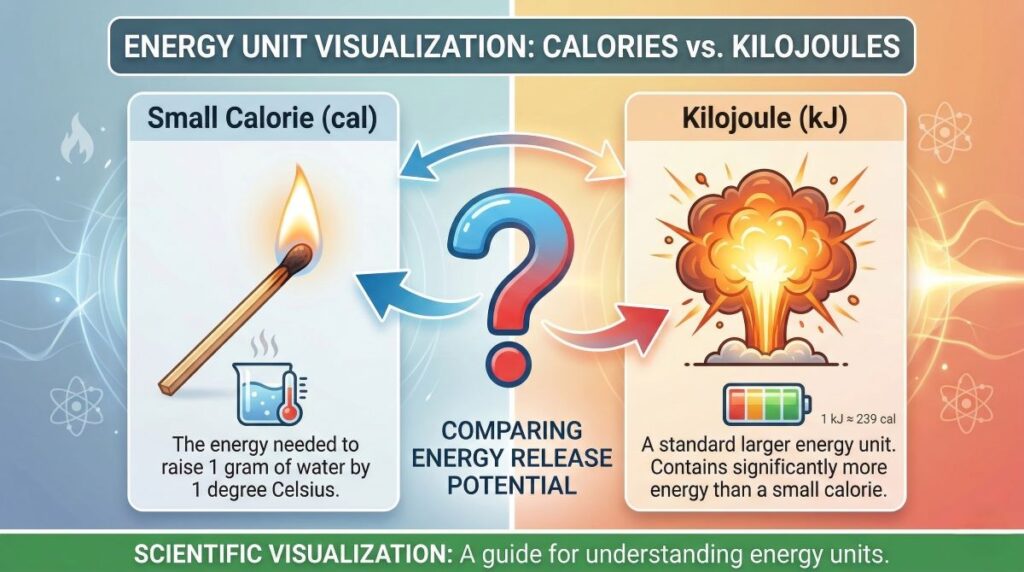
“kJ” stands for kilojoule. To grasp the kilojoules meaning, we have to step out of the kitchen and into a high school physics classroom for a brief moment. A “joule” is the standard unit of energy in the International System of Units (SI). It measures the energy required to do work. Specifically, one joule is the amount of energy you use to lift a small apple roughly three feet into the air.
Because one single joule represents a tiny amount of energy, scientists and nutritionists use the prefix “kilo,” which means one thousand. Therefore, one kilojoule equals 1,000 joules.
When people ask, “what are kilojoules in food?” or “what does kj mean on a nutrition label?”, they are simply asking how much energy that specific food provides to the human body. Just like a car needs a specific amount of fuel to drive ten miles, your body needs a specific amount of energy—measured in kilojoules—to pump blood, repair muscle, and help you walk to the fridge.
While the scientific definition sounds a bit clinical, the practical reality is simple: kilojoules measure the fuel your body gets from the food and drinks you consume.
Are Kilojoules the Same as Calories?
If both of these terms measure food energy, a common question naturally arises: is kj the same as calories?
The short answer is no. They are not the same unit of measurement, but they do measure the exact same thing.
Think of it like measuring distance. If you ask an American how far away the grocery store is, they might say “one mile.” If you ask an Australian, they will say “1.6 kilometers.” The distance to the store did not change; only the language used to describe it changed. The same logic applies when we look at the difference between calories and kilojoules.
So, are calories and kj the same mathematically? Absolutely not. A calorie is a much larger unit of energy than a joule. To put it simply, it takes more kilojoules to represent the same amount of food energy. This is why a snack that contains 200 calories will proudly display a much more intimidating number—roughly 836 kJ—on an international nutrition label.
The Metric vs. Imperial Divide
The reason we have two different measurements comes down to geography and history.
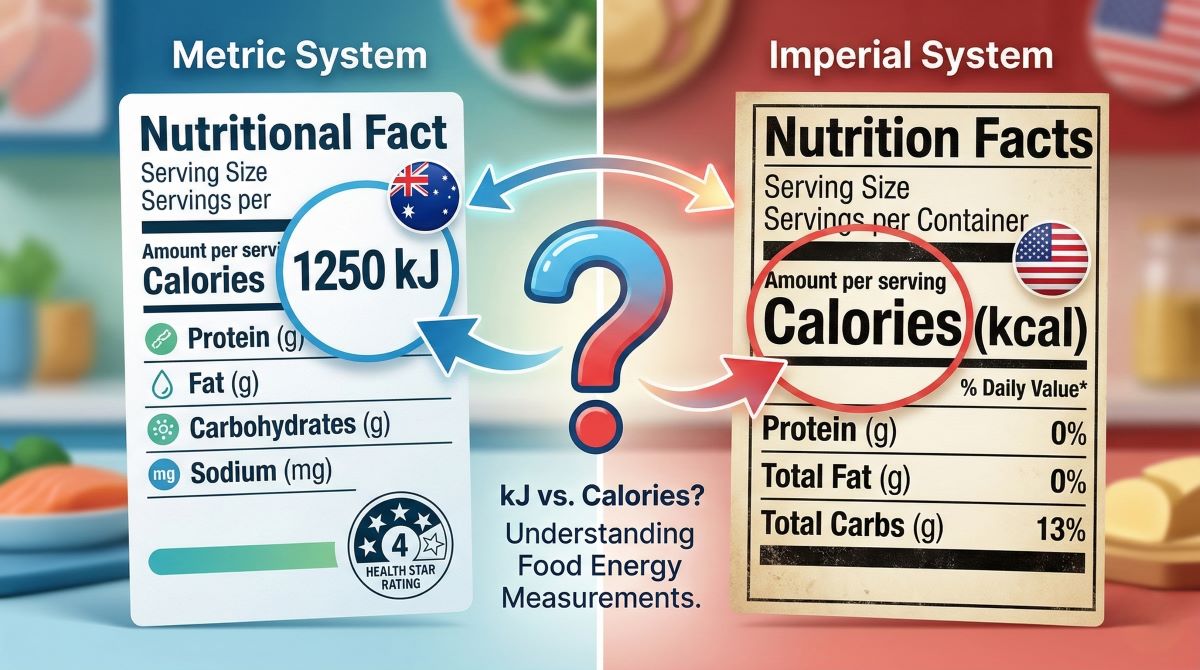
- The Calorie (Imperial): The calorie is an older unit of measurement, historically tied to the imperial system. The United States still primarily uses the calorie (specifically, the kilocalorie or kcal) as its standard unit of food energy. The US Food and Drug Administration (FDA) mandates that nutrition facts panels list energy in Calories.
- The Kilojoule (Metric): The kilojoule is the modern metric measurement. Countries that have fully adopted the metric system—such as Australia, New Zealand, and South Africa—use kilojoules as their standard. For example, Food Standards Australia New Zealand (FSANZ) requires food labels to list energy strictly in kilojoules, though many brands choose to list calories alongside them voluntarily. The UK and the European Union usually display both units side-by-side to avoid confusion.
When you ask if kilojoules are the same as calories, remember that they are just two different languages describing how much fuel a food gives your body.
How to Convert kJ to Calories
Now that we understand the definitions, let us tackle the practical math. If you live in the US but prefer an Australian fitness app, or if you live in New Zealand but read American diet blogs, you need to know how to work out calories from kj.
The Magic Number: 4.184
To perform the conversion, you need to know exactly how many kilojoules in a calorie.
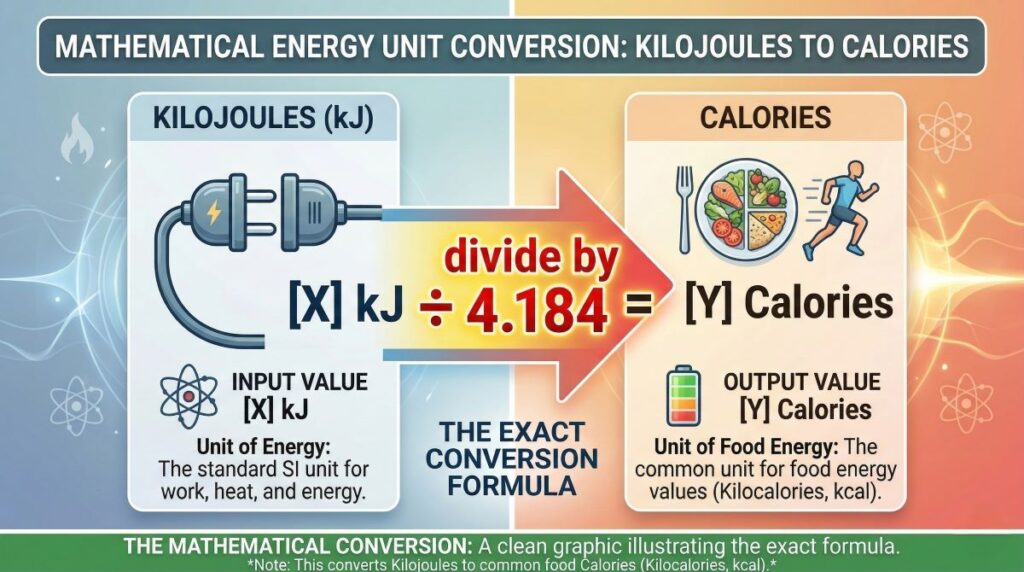
1 Calorie (kcal) = 4.184 kilojoules (kJ)
Because one calorie holds slightly more than four times the energy of a single kilojoule, you must use division to find your answer.
If you want to know how to convert kilojoules to calories accurately, you take your total kilojoule amount and divide it by 4.184.
The Formula: Total kJ ÷ 4.184 = Total Calories
Example 1: You have a yogurt pouch that lists 600 kJ. 600 ÷ 4.184 = 143.4 Calories.
Example 2: You buy a sports drink that lists 1200 kJ. 1200 ÷ 4.184 = 286.8 Calories.
The “Divide by 4” Shortcut
While the exact math is great for scientists, nobody wants to pull out a calculator in the middle of a grocery store aisle. If you just want to know how to convert kj to calories quickly in your head, simply divide the kilojoule number by 4.
If a sandwich has 1600 kJ, dividing by 4 gives you a rough estimate of 400 Calories. (The exact math is 382 Calories, but 400 is close enough to help you make an informed dietary choice on the fly!).
The Better Way: Use Our Free Converter Tool
Let’s be honest: even dividing by four gets tedious when you track multiple meals a day. If you want precise tracking without the mental gymnastics, you should stop doing the math yourself.
We highly recommend using our Free kJ to Calories Converter Tool located right here on this website. Simply type the number from your food label into the box, and the tool will instantly provide the exact Calorie equivalent. It works perfectly on mobile devices, making it the ultimate grocery shopping companion.
The “Big C” vs. “Little c” Confusion
To be a true master of nutrition labels, you need to understand one final quirk about calories. Sometimes, the scientific community makes things harder than they need to be.
In strict scientific terms, a “small calorie” (cal) is the energy needed to heat one gram of water by one degree Celsius. However, this unit is far too tiny to use for food. Instead, nutritionists use the “kilocalorie” (kcal), which equals 1,000 small calories.
Here is the frustrating part: everyday people, food manufacturers, and dietitians simply call kilocalories “Calories” with a capital C. So, when you look at a food label and see “200 Calories,” you are actually looking at 200 kilocalories. Fortunately, you do not need to worry about this minor detail for your daily meal tracking. Just remember that Calories and kcals represent the exact same thing on modern food packaging.
Real-World Comparisons: What Do the Numbers Look Like?
Sometimes, the easiest way to grasp the difference between calories and kilojoules is to see them side-by-side. The average adult requires roughly 2,000 Calories per day to maintain their weight. In metric terms, this equates to roughly 8,700 kilojoules per day.
Here is how common foods translate across the two measurement systems:
- Medium Apple: 95 Calories = 397 kJ
- Large Hard-Boiled Egg: 78 Calories = 326 kJ
- A Standard Slice of Bread: 80 Calories = 335 kJ
- A Fast-Food Cheeseburger: 300 Calories = 1,255 kJ
- One Tablespoon of Olive Oil: 119 Calories = 498 kJ
Notice how quickly the kilojoule numbers inflate! This visual inflation is exactly why tourists often panic when they buy a fast-food meal abroad and see “4,000” listed next to a standard burger. It isn’t a heart attack on a plate; it is just the metric system at work.
Setting Up Your Devices and Fitness Trackers
If you wear a smart watch or use a diet tracking app, you might find that your device defaults to a measurement system you don’t recognize.
Most major technology brands, including Apple, Garmin, and Fitbit, set their default energy measurements based on the region you selected during setup. If you bought your phone in Sydney, your Apple Watch will likely track your workouts in kilojoules. If you bought it in New York, it will count Calories.
Fortunately, you are never locked into these defaults. You can easily open the health settings on your smartphone and toggle between calories vs kilojoules. We recommend picking the unit of measurement that matches the food labels in your specific country. This makes logging your meals and tracking your exercise deficits seamless and frustration-free.
The Final Verdict
Understanding your nutrition shouldn’t require an advanced degree in physics. While the terminology can seem overwhelming at first glance, the underlying concepts are straightforward.
Whether you count calories or track kilojoules, you are doing the exact same thing: monitoring the energy you put into your body. Neither measurement is inherently better or more accurate than the other. They are simply two sides of the same nutritional coin.
The next time you find yourself staring at an unfamiliar food label wondering what is kilojoules, remember the golden rule: divide the big number by 4.184 to find the Calorie equivalent.

Ready to stop doing the math in your head? Bookmark our Instant kJ to Calories Converter Tool right now. Whether you are meal-prepping for the week, traveling abroad, or trying to configure a new fitness tracker, our tool provides fast, mathematically perfect conversions with a single click. Would you like me to guide you to the converter tool so you can try it out on your favorite snack right now?